


Page 21 - Architects Design and Installation Manual
P. 21
Quick Facts                                                        Page |   21

       ● Wrap the DPC around the cavity batten and        Vertical DPC-Reveals
         then around the face of the SureCav panel
                                                             Procedure for reveals
       ● Seal door/window frame with silicon
                                                                     Timber-frame


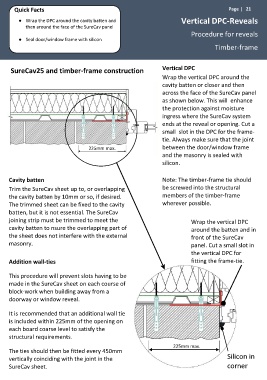
    SureCav25 and timber-frame construction         Vertical DPC
                                                    Wrap the vertical DPC around the
                                                    cavity batten or closer and then
                                                    across the face of the SureCav panel
                                                    as shown below. This will  enhance
                                                    the protection against moisture
                                                    ingress where the SureCav system
                                                    ends at the reveal or opening. Cut a
                                                    small  slot in the DPC for the frame-
                                                    tie. Always make sure that the joint
                             225mm max.             between the door/window frame
                                                    and the masonry is sealed with
                                                    silicon.


    Cavity batten                                   Note: The timber-frame tie should
    Trim the SureCav sheet up to, or overlapping    be screwed into the structural
    the cavity batten by 10mm or so, if desired.    members of the timber-frame
    The trimmed sheet can be fixed to the cavity    wherever possible.
    batten, but it is not essential. The SureCav
    joining strip must be trimmed to meet the                Wrap the vertical DPC
    cavity batten to nsure the overlapping part of           around the batten and in
    the sheet does not interfere with the external           front of the SureCav
    masonry.                                                 panel. Cut a small slot in
                                                             the vertical DPC for
    Addition wall-ties                                       fitting the frame-tie.

    This procedure will prevent slots having to be
    made in the SureCav sheet on each course of
    block-work when building away from a
    doorway or window reveal.

    It is recommended that an additional wall tie
    is included within 225mm of the opening on
    each board coarse level to satisfy the
    structural requirements.
                                                       225mm max.
    The ties should then be fitted every 450mm
    vertically coinciding with the joint in the                         Silicon in
    SureCav sheet.                                                      corner

