


Page 12 - Architects Design and Installation Manual
P. 12
Page |   12                                  Quick Facts
    Carbon Footprint                              ● Recycling avoids landfill or incineration

    100% recycled polypropylene                   ● Much lighter than concrete blocks

                                                  ● Savings and all-round benefits

    SureCav is now 100% recycled polypropylene
    Instead of ending up as landfill or incineration material, SureCav is manufactured by the injection
    moulding  process  to  produce  a  building  material  that  shows  we  care  for  the    environment.
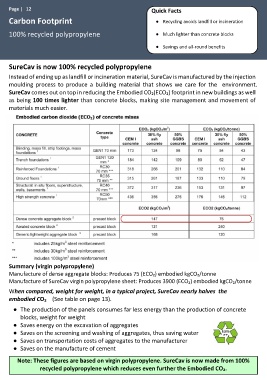
    SureCav comes out on top in reducing the Embodied CO₂(ECO₂) footprint in new buildings as well
    as being 100 times lighter than concrete blocks, making site management and movement of
    materials much easier.


    Summary (virgin polypropylene)
    Manufacture of dense aggregate blocks: Produces 75 (ECO₂) embodied kgCO₂/tonne
    Manufacture of SureCav virgin polypropylene sheet: Produces 3900 (ECO₂) embodied kgCO₂/tonne
    When compared, weight for weight, in a typical project, SureCav nearly halves  the
    embodied CO₂    (See table on page 13).
     ● The production of the panels consumes far less energy than the production of concrete
       blocks, weight for weight
     ● Saves energy on the excavation of aggregates
     ● Saves on the screening and washing of aggregates, thus saving water
     ● Saves on transportation costs of aggregates to the manufacturer
     ● Saves on the manufacture of cement
      Note: These figures are based on virgin polypropylene. SureCav is now made from 100%
              recycled polypropylene which reduces even further the Embodied CO₂.

